Showing posts with label Off topic. Show all posts
Showing posts with label Off topic. Show all posts
Tuesday, May 26, 2015
My new company: Combine Games; My new game: Rails and Riches
Thought I'd share the news, if you hadn't heard. A few friends and I just started a new company called Combine Games based in the Seattle area. We are running a Kickstarter to fund a game called Rails and Riches. You can think of it as a successor to Railroad Tycoon, because Franz Felsl, the designer and artist on Railroad Tycoon 2 and 3 is our lead designer and CCO. You can find us at http://www.railsandriches.com/, or on Facebook: https://www.facebook.com/RailsAndRiches. I just posted a long blog over there: http://www.railsandriches.com/blog/view/6. Come make an account, share or like on Facebook. And keep an ear out for when the Kickstarter goes live.


Tuesday, December 14, 2010
"Restraint in what you ask for is the key to success" - Arnold's Aphorism
A good friend of mine sent me an email about our current sprint (we use a relatively formal Scrum process), encouraging us to define our stories such that the team could experience a success. He is also a great student of military history. I assumed the quote below was from some past general or philosopher. He claims not. So I've named it after him and am spreading the word.
"Restraint in what you ask for is the key to success" - Arnold's Aphorism
I can picture Napoleon fighting with himself over asking his men to achieve a little too much and fail. Or ask less and wind up with better morale. Applying this to software engineering teams makes a lot of sense. If you always ask for more than can be successfully completed, the team may feel unsuccessful/underachieving, and you may feel disappointed. When in fact, they are doing almost the same work whether you expected more or not.
Here's the thing, though. It's been said before. In all things, moderation. Time management, and interpersonal relationship books talk about expectation management. "Under promise and over deliver". The pessimist is never disappointed and often surprised. Live beneath your means. "Let go". Thou shalt not covet.
This is probably more true of things we ask of ourselves: get this, do that, convince them...
What struck me in the phrasing of this old-new aphorism is how clearly it shows that you have the *choice* in setting the expectations. And yet, that goal is the very thing that defines success. And for many goal-oriented folks like us, that success defines our happiness. Ergo, we choose to be happy. Or not.
But it requires self discipline. Not so much in the exercise of effort, but in the restraining of wanting.
You may have heard analyses of the great American marketing machine. It generates unrequited desires, while offering to fulfill them (for a price). The promise of happiness. Oddly, it is more commonly the restraint of those desires that leads to happiness, not the fulfillment.
I think you are going to see many more instances of this wisdom over then next while. See if you can't identify the aspect that you control.
"Restraint in what you ask for is the key to success" - Arnold's Aphorism
I can picture Napoleon fighting with himself over asking his men to achieve a little too much and fail. Or ask less and wind up with better morale. Applying this to software engineering teams makes a lot of sense. If you always ask for more than can be successfully completed, the team may feel unsuccessful/underachieving, and you may feel disappointed. When in fact, they are doing almost the same work whether you expected more or not.
Here's the thing, though. It's been said before. In all things, moderation. Time management, and interpersonal relationship books talk about expectation management. "Under promise and over deliver". The pessimist is never disappointed and often surprised. Live beneath your means. "Let go". Thou shalt not covet.
This is probably more true of things we ask of ourselves: get this, do that, convince them...
What struck me in the phrasing of this old-new aphorism is how clearly it shows that you have the *choice* in setting the expectations. And yet, that goal is the very thing that defines success. And for many goal-oriented folks like us, that success defines our happiness. Ergo, we choose to be happy. Or not.
But it requires self discipline. Not so much in the exercise of effort, but in the restraining of wanting.
You may have heard analyses of the great American marketing machine. It generates unrequited desires, while offering to fulfill them (for a price). The promise of happiness. Oddly, it is more commonly the restraint of those desires that leads to happiness, not the fulfillment.
I think you are going to see many more instances of this wisdom over then next while. See if you can't identify the aspect that you control.
Sunday, December 20, 2009
(Real) Science IS political, sorry to disillusion you
There is the big "climate gate" hoo-haw in the media right now. Reporters are acting surprised that some leading scientists were caught manipulating scientific literature to silence skeptics and dissenters. They convinced peers to knock skeptics' articles, journals to reject skeptics' papers, remove peers from paper review committees if they passed skeptics' papers, and even shut down journals that published dissenting views. Maybe even fudged their data.
Hey! Science is supposed to be awesome. It always eventually gets it right. Real science is about reproducible experiments and validated results. Actually, no, it is political. Like most other human endeavors.
I bet you've done the same things. Maybe at work. Tried to shut down "the competition". Competing for attention, or a raise, or recognition... You know what would be better? Listen to those that disagree and make sure they know you have heard them. They are trying to make the best decisions they can given their background. No one tries to make dumb decisions. If they are wrong, I'm sure they would appreciate learning something they don't know. Or, maybe they have something to teach you.
Imagine! Learning something from someone that disagrees with you and you find irritating. A dissenter. A skeptic. Seems like those that shut down dissent are not just closed minded, but unwilling to learn. Such a scientist should be embarrassed for themselves. Isn't IDEAL science supposed to be about discovery? Too bad that in reality there is so little ideal science, and so much science influenced by the politics of "real-life science".
- Galileo and other historical scientists were shut down by their community. Granted, their scientific peers were not basing their views on empirical data. But many modern scientists still base their views on what they've been taught, not what they've measured. This is understandable, you have to stand on the shoulders of giants to have time to make advances.
- Views are often validated by currently understood standards. If you plot the published speed of light against the year of publication, you will see sequences of flat spots where a value is almost identical to what was previously "measured". And then there is a jump; followed by another flat period of many years. Is this because they were using the same equipment and experimental procedure? Or because anyone that tried to publish a different "answer" was considered a skeptic and shut down? Again, this is understandable. Humans tend to try to be consistent, and not be antisocial and go against the crowd. It requires extra diligence to disprove a well respected master in their field. Like the great Einstein when quantum physics popped up. (Wait! Maybe God changes the real speed of light periodically as a joke!)
- Scientists are funded. Based on whether they get published or referenced. Or if they agree with the "sponsoring" corporation. So the system manipulates them into agreeing with the crowd. But the underbelly of the scientific community is less pretty than what we might have thought of as this kind of indirect pressure.
- Journals are funded. If the larger community of scientists don't subscribe to that journal offers, or schools or corporations pull their funding (or advertising!), a venue of dissent/questioning dies.
- I've seen public "attacks" during a presentation of research. In the form of a "question". Being honest, these questions are self-aggrandizing. E.g. "what makes you think that you are right when I have already published the opposite". It can embarrass a young scientist and discourage them from disagreeing in the future. Only the thick-skinned "crazies" keep at it. Like Tesla.
- I've been on paper review committees where papers are summarily discarded. There are so many that only one or two of the reviewers are assigned to read a given paper before the meeting. If they didn't understand it, or disagreed with the findings (based on their own experience/bias), it can get tossed very quickly. There are a lot to get through. Even when it is "marginal", the shepherding process can be taxing, discouraging a reviewer from volunteering. After all, they are contributing their expertise, but don't get their name on the paper. (Suggestion: maybe they should. If they pass something that proves incorrect, they lose points. As an incentive to get it right. Or would that discourage participation?). For "workshops" (not full Journals) an author's name is sometimes on the paper being reviewed, so their reputation is considered.
- As science get more "fine", some experiments cannot be reproduced except on the original equipment or by the original experts. Think CERN and supercolliders. (Or cold fusion?) Who has another billion dollars just to *reproduce* a result? Unless the larger community thinks a result is hogwash and feels motivated to pool their resources and dump on the results. So who is going to disagree? It almost sounds like a religion at that point.
I bet you've done the same things. Maybe at work. Tried to shut down "the competition". Competing for attention, or a raise, or recognition... You know what would be better? Listen to those that disagree and make sure they know you have heard them. They are trying to make the best decisions they can given their background. No one tries to make dumb decisions. If they are wrong, I'm sure they would appreciate learning something they don't know. Or, maybe they have something to teach you.
Imagine! Learning something from someone that disagrees with you and you find irritating. A dissenter. A skeptic. Seems like those that shut down dissent are not just closed minded, but unwilling to learn. Such a scientist should be embarrassed for themselves. Isn't IDEAL science supposed to be about discovery? Too bad that in reality there is so little ideal science, and so much science influenced by the politics of "real-life science".
Tuesday, June 16, 2009
Off Topic: Most common solid waste?
OK. Weird thought... If you went to a landfill, what would be the most common solid waste you saw? A number of years back, a greeny asked that question and challenged people to go see for ourselves. It's been bugging me ever since. Here are some quick Googled results.
The most common waste product is paper (about 40 percent of the total). Other common components are: yard waste (green waste), plastics, metals, wood, glass and food waste. The composition of the municipal wastes can vary from region to region and from season to season. (U of Cal)
Paper, Organics (in Canada, from an Amazon "search inside" book)
Malaysia: Plastic waste is the most common solid waste that we generate in the country accounting for 7-12 percent by weight and 18-30 percent by volume of the total residential waste generated.
Throwaways (diapers) comprise 2 percent of the nation's solid waste by weight, making them the third most common solid waste item after newspapers and beverage and food containers. (diaper "activist" site, NY)
So "paper" is #1 and is quite recyclable, and energy rich. Plastic and organics too (possibly #2 and #3, if you include diapers; heh!).
Still doesn't answer what the "source" of the paper and plastic is. Fast food bags and wrappers? Retail boxes/packaging, grocery packaging, industrial/wholesale packaging? Books, junk mail, printouts?
I'd love to have a reference to a more detailed discussion of the source data. Not the reinterpreted-for-an-agenda summaries. And then make my own conclusions about reducing. (Maybe I should just look in *my* trash can at the end of the week).
The most common waste product is paper (about 40 percent of the total). Other common components are: yard waste (green waste), plastics, metals, wood, glass and food waste. The composition of the municipal wastes can vary from region to region and from season to season. (U of Cal)
Paper, Organics (in Canada, from an Amazon "search inside" book)
Malaysia: Plastic waste is the most common solid waste that we generate in the country accounting for 7-12 percent by weight and 18-30 percent by volume of the total residential waste generated.
Throwaways (diapers) comprise 2 percent of the nation's solid waste by weight, making them the third most common solid waste item after newspapers and beverage and food containers. (diaper "activist" site, NY)
So "paper" is #1 and is quite recyclable, and energy rich. Plastic and organics too (possibly #2 and #3, if you include diapers; heh!).
Still doesn't answer what the "source" of the paper and plastic is. Fast food bags and wrappers? Retail boxes/packaging, grocery packaging, industrial/wholesale packaging? Books, junk mail, printouts?
I'd love to have a reference to a more detailed discussion of the source data. Not the reinterpreted-for-an-agenda summaries. And then make my own conclusions about reducing. (Maybe I should just look in *my* trash can at the end of the week).
Monday, April 20, 2009
How to ignore most emails (safely)
At work, I use Outlook. It has "organization" tools. One of the best is found here: View/ArrangeBy/Custom/AutomaticFormatting. It gives you a set of conditions and formatting for each line in the list view. I use the default of unread mail formatting with a bold font.
1) I use my favorite font color for emails that are sent only to me: select "where I am:" "the only person on the To line". Even if others are CC'd on this email, it was sent directly to you. You'd better read it. No one else will.
2) My second favorite font color for emails sent specifically to me (and others): select "where I am:" "on the To line with other people". Someone took the time to direct this email directly to you and some of your peers. You should probably read it. Maybe one of your peers will respond, but you never know.
3) My third favorite font color for emails that I was specifically CC'd on: select "where I am:" "on the CC line with other people." (also covers where you were the only person on the cc line). Someone took the time to include you on the thread, but you know it is FYI (for your information) only, so you can almost certainly ignore it without getting in trouble, or until you have some time. This allows you to decide based on the subject line, for example. Many #3's turn into someone else's thread, and I can get by with skimming only a couple of those.
4) My least favorite color is "all the rest", and will be the default formating. These will almost always be delivered to you because you are on an email group. These can almost always be ignored for several days. If you happen to be on one or two where that is not the case, make a custom rule to highlight these. If you are on a ton of groups that each need immediate attention, you are probably doing something else wrong that I can't give you emperical advice about. I know I wouldn't survive long under that kind of stress. Don't borrow that kind of trouble. Seriously consider whether your response in those forums is honestly needed so urgently. I'l bet if you ignore it and you are the only one that can respond, you are eventually going to get a #1 or #2 email on it.
I also use a custom font color for "followup" emails that I have specifically marked as needing my attention later. Not only do they show up as red, but they sort to the "bottom" of my list view (I read my list like a console window scrolls.
I don't empty my inbox. I think that is "busy work", and just puts important items out of view in other mail boxes where I wind up forgetting about them. I only open half or 2/3rds of my emails, and only when I decide I have time. I'll flip the window open (left on list view) and see if there are any #1's and then just close it. That means almost half my emails are left in the "bold" state, and I don't feel guilty about that. Those are emails that were broadcast, not sent "to" me expecting me to solve a problem. They were FYI to me. If it was an important broadcast, it probably had the "high priority" flag set.
I also use the preview window and set auto-read on (marks the item as read if you "preview" it for more than a few seconds). If I get the sense I need to read this more carefully or later, I'll manually flip it to unread so it stands out and I'll reevaluate it later.
These tricks work well in meetings when you think you need to glance at your queued emails, or any other time when you are very pressed for time. A simple glance at the font colors gets you focused on the one or two emails you should look inside. Often there is little or nothing to do with even those, so mark them unread for when you have a block of time to "clear" the backlog.
1) I use my favorite font color for emails that are sent only to me: select "where I am:" "the only person on the To line". Even if others are CC'd on this email, it was sent directly to you. You'd better read it. No one else will.
2) My second favorite font color for emails sent specifically to me (and others): select "where I am:" "on the To line with other people". Someone took the time to direct this email directly to you and some of your peers. You should probably read it. Maybe one of your peers will respond, but you never know.
3) My third favorite font color for emails that I was specifically CC'd on: select "where I am:" "on the CC line with other people." (also covers where you were the only person on the cc line). Someone took the time to include you on the thread, but you know it is FYI (for your information) only, so you can almost certainly ignore it without getting in trouble, or until you have some time. This allows you to decide based on the subject line, for example. Many #3's turn into someone else's thread, and I can get by with skimming only a couple of those.
4) My least favorite color is "all the rest", and will be the default formating. These will almost always be delivered to you because you are on an email group. These can almost always be ignored for several days. If you happen to be on one or two where that is not the case, make a custom rule to highlight these. If you are on a ton of groups that each need immediate attention, you are probably doing something else wrong that I can't give you emperical advice about. I know I wouldn't survive long under that kind of stress. Don't borrow that kind of trouble. Seriously consider whether your response in those forums is honestly needed so urgently. I'l bet if you ignore it and you are the only one that can respond, you are eventually going to get a #1 or #2 email on it.
I also use a custom font color for "followup" emails that I have specifically marked as needing my attention later. Not only do they show up as red, but they sort to the "bottom" of my list view (I read my list like a console window scrolls.
I don't empty my inbox. I think that is "busy work", and just puts important items out of view in other mail boxes where I wind up forgetting about them. I only open half or 2/3rds of my emails, and only when I decide I have time. I'll flip the window open (left on list view) and see if there are any #1's and then just close it. That means almost half my emails are left in the "bold" state, and I don't feel guilty about that. Those are emails that were broadcast, not sent "to" me expecting me to solve a problem. They were FYI to me. If it was an important broadcast, it probably had the "high priority" flag set.
I also use the preview window and set auto-read on (marks the item as read if you "preview" it for more than a few seconds). If I get the sense I need to read this more carefully or later, I'll manually flip it to unread so it stands out and I'll reevaluate it later.
These tricks work well in meetings when you think you need to glance at your queued emails, or any other time when you are very pressed for time. A simple glance at the font colors gets you focused on the one or two emails you should look inside. Often there is little or nothing to do with even those, so mark them unread for when you have a block of time to "clear" the backlog.
Thursday, September 18, 2008
Off Topic: Recycle Aluminum Cans?
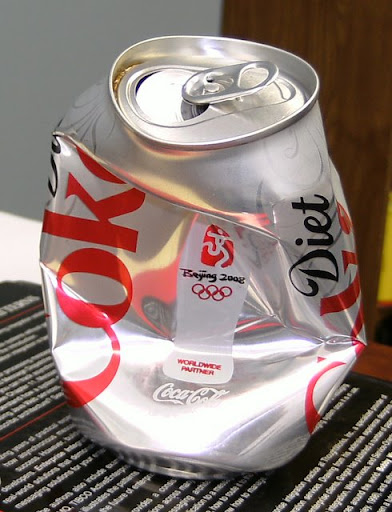
A quick Google search will show a ton of pages that claim something like "recycling one aluminum can will save enough energy to power a 100 watt light bulb for almost 4 hours". That is actually an awful lot of energy. You could go burn your hand on it any time for 4 hours. Such statistics (all statistics?) make me go "what? really?".
Probably what they mean, since it would be the easiest to measure/compute is power-to-create-from-bauxite minus power-to-create-from-a-can. That doesn't even begin to answer the question.
What about mining and delivery of the bauxite, and other overheads on that end? What about the energy used to collect or separate the cans, and bring them to the plant? I assume things like cleaning and sterilizing are included in power-to-create-from-a-can. And I would discount the human cost of picking them out of the trash, or dropping them in the recycling bin.
Just try to find that information with Google! Or even determine which data is included in the quoted stat. The numbers and wording make me wonder whether all the pages are quoting each other. Maybe the first guy to say it made it up.
Here is a skeptic:
http://www.perc.org/pdf/ps28.pdf
Back to stuff I know something about...
Subscribe to:
Posts (Atom)